Showing posts with label Ian lockwood. Show all posts

Friday, September 9, 2011

Ian Lockwood’s First Week at Harvard University as a Loeb Fellow


I had clothing and shelter but needed food.  Man cannot live on homemade chocolate cookies and muffins alone.  Plus, my supplies of both were dwindling.  To increase my foraging range, I took a look at the bike that Bryan Bell, from the Class of 2011, had given to me during our orientation a few months ago.  He was right.  It was a beater.  In fact, it was the definition of a beater.  It was the beater to beat all beaters.  It was a 1960s, green-colored, steel-framed, steel-rimmed, Raleigh 10-speed.  Remember those?  The chain was rusted stiff, neither derailleur functioned so it really was a one speed, and the seat was permanently stuck in the lowest position.  On the upside, the front brake appeared to work and both tires held air despite the cracks.  With plenty of oil, a pair of pliers, and some elbow grease, I loosened the chain up and got it functioned again.
Peter Park and his cool (functioning) old bike
I headed out for provisions on my one-speed bike that masqueraded as a ten-speed.  I made it all the way to the end of the driveway and aborted.  The front brake pads may as well have been made of the same steel as the rim.  They were not very effective.  The bike was relegated back to the basement and I walked.  Nearby, there was an expensive little market where I bought the essentials.  Over the course of the week, I would learn about two Whole Food stores, a Trader Joes, and a Shaws (the closest thing that resembles a regular grocery store), all within a two-mile radius.
It didn’t take me long to set up my room back at the Doebele House.  My roommates would show up one by one.  Peter Park was the first, who was the former Planning Director from Denver.  I remembered his diverse interests from the orientation that included better codes, transportation systems, partnerships, public engagement processes.  He had been around a couple of highway removals before, one in Milwaukee and one in Denver, so we definitely had some common interests.

Andres Lepik (left) and me in our kitchen.  Andres turned
out to be quite the chef which is very cool.
Andres Lepik was the second.  He was an architecture curator in Berlin as well as at the Museum of Modern Art and New York City.  He was interested in how one would curate a show in the future when, increasingly, architects and other designers do their work digitally.  What would hang on the walls when there was no paper?  Would there even be walls?  What would a show look like?  Would there be any physical models?  Would museums become somewhat virtual places that people would visit over the internet?  Andres seemed like a very creative person so I was sure he had some ideas and I was curious to see what he would come up with.

Chris Calott, a professor, architect, and developer
The final roommate to arrive was Chris Calott.  He is a practicing architect and developer, based in Albuquerque, New Mexico.  He had worked all over the US and Mexico and used to be a professor.  He really gets the Hispanic and Native American cultures and does a variety projects with varying densities and mixes of land uses.  Chris has an encyclopedic knowledge of architecture, architecture history, and contemporary trends and debates which makes for great conversation and opportunities to learn.  He interests for the Loeb Fellowship were diverse but his focus is on finance mechanisms for affordable housing.  In addition to having diverse interests, my three new amigos all seemed compatible and capable for having a bit of fun.
Class selection would be happening in a couple of days, so Jim and Sally had to brief us on several subjects and get us organized for the year.  They reviewed the material that they had previously covered during the orientation and went into more detail on schedules and responsibilities.  We would be involved in organizing weekly seminars (some public and some just with the Fellows), weekly dinners during which we would arrange guest speakers, the odd symposium, helping out with studios, and our course work.  Every week was going to be packed.  There would also be three trips, one to Maine, one to Vancouver, and one to India.  Jim and Sally reviewed the purposes of the trips and the dates.

Jim inviting the students and faculty to our three-day event
Jim and Sally had big posters made with the nine Fellows' names printed in huge letters advertising our "introductions" to the GSD.  Jim made a very nice speech to the students and faculty, inviting them to attend our introductions.  The idea was that, for three days in a row, a lunch would be served to whoever showed up to listen.  Each day, three of the nine Fellows would describe their work and interests at the GSD.  Somehow, I was selected to go first on the first day. 
Jim and Anna Heringer (also a Loeb Fellow) enjoy Andres'
reaction to an historically significant and rare book
from the Francis Loeb Library's extensive collection.
Jim and Sally also arranged a spectacular tour of the Frances Loeb Library, apparently the best architectural library on the planet.  Over several hours, various librarians took turns showed us tiny samples from their huge collections.  It was absolutely fascinating stuff.  Any one of us could spend our entire year in the library looking through the collections.  The librarians were given the heads up, by Sally and Jim, on what our interests were and they had chosen artifacts accordingly.   They nailed it.  Every one of us will be going back there as often as we can.  We also were briefed on all things computer by the GSD’s top computer expert, a really helpful guy named, Hal, which I hope was a coincidence.  Lastly, we attended a lecture on the history of the Graduate School of Design which was helpful because it allowed us to understand why the school was so big on modernism and landscape urbanism for example.  Its current leanings and teachings have roots that go right back to its founders.


Jim and Jean Lauer (also a Loeb Fellow)
discuss the sites on the walking tour

Jim and Sally also took us on a bus ride into Boston to show us the ropes for the "T" which is what they call the transit system here.  Once we got to Boston, we went on a wonderful walking tour and had supper at the famous Durgin-Park Restaurant.  We saw wonderful streets, parks, and buildings some which great design and others that were horrible (like the modern City Hall building).


Eight of the nine Fellows in a park with Jim and Sally


Bike Share Program in Boston


Five Fellows and Sally enjoy Sue's wonderful cooking

I suppose Jim and his wife, Sue, were worried that we hadn't managed to make it to a grocery store yet.  They, generously, had us all over for a meal.  Their place had a large back yard with a patio where we had a little reception.  The patio was centered behind the house, a basketball area was to one side, and a lawn was to the other.  The fairly complete tree canopy gave the yard a comfortable sense of enclosure.  The reception was followed by a very tasty buffet that was waiting for us in their lower party room. 


I brought my road bike with me with the intensions of tagging along with one of the bike groups for the odd Saturday morning ride.  However, I picked the wrong group.  These guys don’t go for Saturday morning rides; they go out to determine who the alpha male is over a 75 to 80 mile course.
I planned on cutting the distance in half and it ended up being even shorter than that.  They were all A-riders and some collegiate racers.  They all had trained hard over the summer and were eager to show off their watt-generating capabilities.  I was a B-rider, twice their age, who hadn’t ridden in a while.  Needless to say, it wasn’t long before I knew that I was going to get dropped like a rock and be lost in nowhere Massachusetts.  I tucked in behind one of taller riders to minimize my effort but that was not enough.  Furthermore, the road surfaces were uneven, pitted, and pot-holed.  It was like operating jack-hammer while riding a bike.  I was not enjoying the ride on any level.  Ringing in the back of my head, I could hear two of Jim’s and Sally’s many pieces of advice; i) if it is not enjoyable stop and ii) try new things.  It was at that moment when I slowed up and let the peloton disappear over the hill.  I concluded that I would try the myriad of unfamiliar exercise options available through the extensive athletic facilities at Harvard, use my bike for more leisurely rides with my fellow Fellows, and get back into the road scene after my time at Harvard.  I humbly and happily returned to the Doebele House, content with my decision.
Standing room only as students decide if the class
is of interest to them
Choosing classes was difficult.  I was interested in dozens of the classes and the recommended load was three.  It was even tougher because the numerous classes at MIT and other schools in the area were available as well.  However, Harvard helped by having “shopping days”.  During this time, the professors would introduce their courses and, afterwards, we got to select.  The trick was to narrow things down prior to the shopping days and then get to your short list’s presentations.  I ended up choosing five courses; two at the Kennedy School of Government, one at MIT, and two at the GSD.  I decided that, if it got to be overwhelming, then I’d drop accordingly.
The first week was achieved on foot.  The beater bike was arguable dangerous.  However, I couldn’t make my schedule work by walking.  The distances were too far.  I couldn’t use my road bike either.  Apparently, the Cambridge bike thieves are professionals and some of the most highly skilled thieves anywhere.  Several sources said that if they can’t steal your whole bike, then they will settle for parts.  Considering that my road bike’s brakes are worth more than the average bike in Harvard Yard, using my road bike for everyday use was not an option.  Plan A was to fix the beater.  I white-knuckled the beater to a reputable local bike shop.  Upon thorough inspections, the beater was worse off than I thought.  Many of the parts were beyond repair, some cracked completely through.  Replacement new parts were no longer available so we’d have to search for compatible old parts.  The bill to get the thing operating again was as much as a new bike and the old bike would still be a beater.  I decided to buy a new cheap bike.  Back to the basement went the beater.
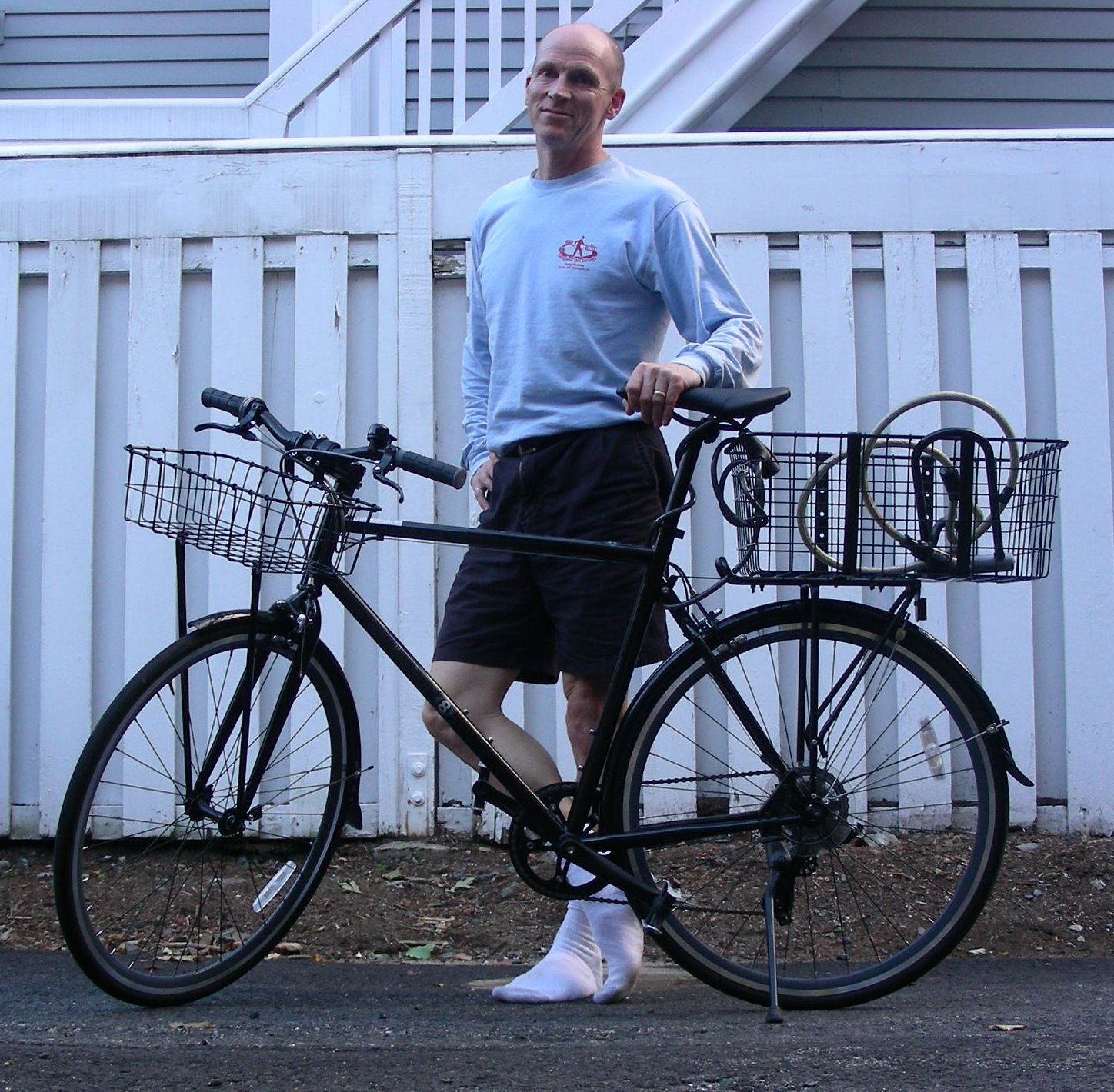
Me with my heavy duty, utilitarian, campus bike 
I hoofed around the local bike store circuit.  Eventually, I ended up at the farthest corner of the campus, the Radcliffe Quad where there is a not-for-profit, on-campus, bike shop with great service and some cool inexpensive bikes.  Quad Bikes, as it’s known, is run by an ex-collegiate bike racer, named Mike, who hires a small team of student bike mechanics to help him out.  Mike set me up with the perfect campus bike.  It’s got seven speeds, fenders front and back, a heavy-duty rear kickstand, aluminum wheels for good braking in wet weather, a basket up front, and a mondo basket on the back.  That bike can carry about six bags of groceries without any hooks or bungee cords.  It weighs a whopping 46 pounds, including the three mandatory locks (one for the seat, one U-bar for one wheel, the frame, and the immovable object; and one cable lock for the other wheel).
So, I was more or less settled in my room with a schedule, food, and wheels.  Symbolically, my wife’s and daughter’s supply of cookies and muffins ran out at the same time.  I was looking forward to diving in and was committed to make a go of whatever was coming.

Ian Lockwood’s Trip to Harvard University


Following the orientation, my family and I had to make a decision about who was coming to Cambridge.  Our first realistic option was that we could all go.  Harvard would house us and help find a high school for Sarah and Evan.  My affiliate (that’s hard to get used to) and children would undoubtedly have all sorts of cool experiences at Harvard and in the area.  It would be a great family adventure. 

Sarah (front middle) and Evan (back left)
with Evan's Orlando Gold Volleyball Team
at 2011 National Championships
Our second option was for me to go alone and have the occasional visit back and forth.  This ended up being our choice.  Sarah and Evan had positioned themselves for roles at their High School that they would not necessarily have at a new high school.  Sarah, in particular, had positioned herself for three years to take on several leadership roles in her senior year, including president of the Quill and Scroll Club and head editor-in-chief of the school newspaper.  She really didn’t want to miss out on those experiences.  She also wanted that experience on her resume so she could better position herself for her college aspirations.  Both children were also heavily involved in their high school’s volleyball program.  In addition, Evan was on a nationally-ranked team with his volleyball club. 
During the months preceding my departure from the office, I finished up what projects I could, transitioned other projects to capable team-mates, passed on my marketing leads, and allocated any new work to others.  Tim, Fabian, and Ed were their steadfastly supportive selves.  Brent Lacy, who is my Service Group Leader, in Orlando, and Paul Moore, a senior transportation engineer from our Atlanta office, were also very supportive.  Both Brent and Paul would likely have to fulfill roles that I would normally have done.  By the end, through a team effort, everything short of a few memos to write was off my plate.  The table was set for reloading my plate at Harvard.
Rented Minivan Packed for Trip
 I rented a Dodge Caravan minivan, packed up my stuff, said my cheerios, and headed north.  Saying “fare well” to my family was the hardest part.  I’d routinely left them over the last twenty-something years for business trips.  However, those trips were generally during the week when they were busy with their schooling and routine.  Those trips rarely lasted more than three to five days and I’d only miss the odd birthday party, school concert, tutoring opportunity, volleyball game, graduation, and so forth.  If something broke around the house, then it would only need to wait a few days and I’d be back to fix it.  This was a different story.  This was for a long time.

My family (Evan, Sarah, and Joanne) and
Evan's friend and teammate, Joel, see me off
The morning of my departure, I gave Joanne, Sarah, and Evan a series of hugs and kisses, told them that I loved them, and asked them to look after each other while I was away.  Sarah had made me a large bag of chocolate chip cookies and my wife had made me a bunch of muffins.  I certainly wasn’t going to starve.  We promised to video conference every Sunday evening.  I left a framed picture of myself in Harvard Yard on the mantel to remind them that I was still there in spirit but had to be in Cambridge because I was doing something important for our family, for our community, and for many other communities.  Leaving home, which seemed so theoretical and far away in December, had become incredibly real.  It was everything I could do to not lose it in front of my family.  I was going to miss them so much.  I was hardly out of the driveway and tears were rolling down my cheeks. 
Traffic Jam en Route
The drive was relatively uneventful for me.  However, it was not uneventful for others.  On the way up, I would occasionally get caught in a traffic jam.  The pattern was the same.  A police car and/or ambulance would race by on the shoulder of the highway, sirens screaming and lights flashing.  The rest of us, highway sheep, would dutifully creep along in our lanes until we got past the blockage.  The odd impatient driver would switch lanes, often more than once, and not seem to get any farther ahead for the effort.  The traffic reports on the radio were less than timely; they would confirm that, yes indeed, there was a traffic jam at my location and that there was an “accident” ahead.  However, what was only an inconvenience to the flock and an “accident” to the lady on the radio lady was a life-altering disaster for the victims and their families.  The pain and suffered were so routine that those not directly involved were not even feeling it any more.  The lady on the radio wasn’t concerned with the father and daughter who just died in a highway ditch; she was concerned about me and my flock-mates being delayed.  I passed several recent crash sites on my way to Cambridge, some of which involved injuries at best.  Each time, the emergency responders were on the crash scene doing their job, tending to the injured and dead, clearing the wreckage, and documenting.  The rest of us gawked as we drove past, accelerated back to 5 mph over the speed limit and lamented, “Gee, it’s lucky that wasn’t us.”

One of Thousands of Crash Scenes Each Month in the USA
The crash scenes reminded me of the big picture, the aggregate of similar scenes being played out on highways and streets across the country.  It reminded me that 30,000 to 40,000 people are killed on American roads annually.  That is the death toll equivalent to the 911 disaster’s death toll every month of every year.  Compared with other countries, the annual collision-related deaths per million people in the United States, at 152, is substantially higher (e.g. France 89, Japan 86, China 82, India 81, Germany 71, and U.K. 56).  Conventional thinkers would say that even though every American’s chance of being killed in a crash is about twice that of citizens from other countries, we drive more than twice as far as they do so our roads are safer per mile driven.  I’m so sick of hearing misleading statistics like that.  It would like saying that Americans exercise less and eat more pounds of highly processed food every year than citizens of other countries and, thus Americans suffer more from various related diseases.  However, conventional thinkers would say we are healthier than citizens in other countries because we have fewer health problems per pound of unhealthy food consumed.  Twisted logic!  Last time I checked, people are being killed in crashes; not miles driven.  God knows how many are injured on the streets and highways in the United States every year.  Now, our emergency responders are doing a great job at the scenes.  I saw that for myself on my way up.  However, my profession, the transportation engineering profession, is doing a terrible job with the big picture; I witnessed that on my way up too.  It reminded me about how important the reform mission is and doing my part in it and why I am away from my family for a while.
Of the four guys who would be sharing the Doebele House, I was the first to arrive.  Sally had mailed me the door key and there was an envelope with my name on it to indicate my bedroom.  I emptied the minivan into my room and returned it with about 10 minutes to go before I’d got charged for an extra day.  I was on the ground.

Sunday, August 28, 2011

Notification that Ian Lockwood was Awarded a Loeb Fellowship at Harvard University

(The events in this post occurred in April 2011)
I felt good about the interviews but really had no clue about how I faired compared with the other 18 finalists.  Being nominated was cool and making the finals was very cool.  I definitely had my fingers crossed, but there was nothing much else for me to do but wait patiently for the decision.  It came surprisingly quickly.  Sally’s e-mail arrived on April 6th only 10 days after my last interview, at exactly 19 minutes after midnight and well after my bed-time.  Oblivious to the life-altering news that was waiting in my in-box, I slept peacefully.  I woke up at the usual time and went through my normal “in-town” morning routine.  Upon arriving at the office, I said, “Good morning” to Barbara, our friendly multi-tasking receptionist, got my usual glass of water, and went to my desk.  I exchanged the usual pleasantries with Danni and Fabian, who always arrived to the office before me, sat in my chair, hooked up my lap top, and checked my e-mail as per normal.  In my mind, everything was fairly routine until I saw the e-mail from Sally, with the subject line saying, “Congratulations!  You are a Loeb Fellow.”  Bang!  Right in the subject line.
My eyes welled up with tears.  I was happy beyond words.  Five months earlier, Joanne encouraged me to take a shot.  Ben pulled the trigger.  Tim, Dan, and Andrew wrote letters.  I’d submitted my application and was interviewed.  AECOM, my colleagues, and my family were supportive in so many ways and at so many levels the entire time.  And the shot hit the bull’s eye.  We had done it!  I was a Loeb Fellow.  This was no longer a normal day.
Silently, I rose from my chair and walked slowly to a spot about half way between Danni’s and Fabian’s desks and, seemingly, about six inches off the floor.  Danni was highly focused on her computer but Fabian noticed me approach and looked up to address me.  As soon as he saw my face, he smiled and said, “You got the Loeb Fellowship, didn’t you?”  Wow, I thought, this guy does have ESP and I replied, “Why do say that?”  He said, “I know you.  I can tell.”  So I fessed up and said, “Yes, I just heard, just now.”  Danni chimed in with a voice about an octave higher than her normal voice and at about twice her normally fast speaking pace,“Yeh!-You-got-it-Congratulations!-I’m-so-proud-of-you!-That’s-so-great.”
I had to tell my wife.  I returned to my chair.  The call went something like this.  Joanne answers her phone, “Hello”.  Short pause. Ian says, “I got it.”   Joanne screams… 
For the next several days, I wanted to spread the word from the roof tops.  However, I couldn’t.  Sally asked me to not spread the news widely because the results had not reached the unsuccessful finalists.  Every successful finalist had to officially accept their offer with an acceptance letter, prior to Sally informing the unsuccessful finalists.  This was necessary in case any of the successful finalists could not accept the Fellowship for whatever reason.  Then Sally could make the offer to the next candidate(s) on her list.  My acceptance letter was written, scanned, and e-mailed within an hour of learning about this requirement.
I did as Sally requested and only told my references, Tim, Dan, and Andrew, as well as Ben and my family.  I also sent an internal office e-mail to my colleagues so that they would get the correct information all at the same time.  After that, and after the acceptances were complete, the news of my Fellowship spread and the reaction was like after my nomination but times five.  I had no idea how fast news travels and how many people would be excited about this opportunity.  E-mails and calls came from diverse geographies, clients, friends, colleagues, and even people whom I’d never met. 
After that, Sally and Jim sent several letters and e-mails about preparing.  They covered everything from health care, to key dates, to finances, to housing, to, “Are you bringing your family?”  The Loeb Fellowship program is so cool that Harvard offered to house my whole family, if that was our desire.  Sally would even help find schools for our children.  Unbelievable!  The opportunities seemed endless.  This was new territory in my circles so my office, Joanne, and I had lots of questions, all of which would hopefully be answered in an upcoming multi-day, on-site, orientation.  Harvard planned to fly the whole Class of 2012, from wherever we were around the world, to Cambridge from May 5th to 8th.

Ian Lockwood’s Loeb Fellowship Application

(The events in this post occurred in December 2010)

One item, from James Stockard’s letter that struck me like a 2x4 was the application deadline of Monday, January 3rd, 2011.  Considering that it was December 6th, and I had to Fed Ex my application to arrive at Harvard University by the 3rd, my real deadline was more like December 29th, just over three weeks away. Among other things, the application asked for four essays and a “portfolio” but, as a transportation engineer, I did not have a portfolio.  I wondered if there was even such a thing as a portfolio for transportation engineers and, if so, what would one look like?  Furthermore, I had several consulting tasks to wrap up before the holidays, not to mention to get ready for the holidays themselves.  So, if anyone is still wondering why the Lockwood home was not decorated for the holidays and why my family and I didn’t get around to sending out a holiday card, now you know why.
The Lockwood Clan's Draft Holiday Card
That being said, there was actually a draft card done.  Before my nomination, the card was nicely on schedule.  After reading the application requirements, it was clear the card was going to be a little late.  I made a few subtle changes to the card to reflect its inevitable lateness, but still didn’t get it finished.  The application had priority and by the time it was complete, the card was too late and got shelved.  However, as you can see, from the draft card, our family’s life in 2010 revolved, to a great extent, around volleyball and the Winter Park High School.  It seemed like we were always somewhere on campus.
The interesting thing about completing a Loeb Fellowship application is that everything has strict word-limits or other limits.  Consider letters of recommendation, for example.  I was fully prepared to bury the selection committee with letters of recommendation.  Over the years, I had worked closely with dozens of mayors, business people, redevelopment agency officials, public works people, architects, planners, engineers, park people, DOT officials, environmental groups, city managers, developers, advocacy groups, urban designers, health officials, and so forth.  I knew people from each group who would be happy to write me a letter.  However, the limit was three letters.  Only three?  The limit for the portfolio was four pieces of work.  What, only four?  I was fully prepared to put together a tome.  Each of the four essays was limited by a word count which amounted to about one page each.  One page each?  There was too much to say!  Upon reflection, however, the strict limits made a lot of sense because the competing design professionals were likely prepared to do the same thing as me and the selection committee would, indeed, have been buried in bulky applications.
The challenge quickly became who to pick for references, what work to choose, and what to write about.  My early conclusion was that there was not even close to enough room to cover everything which made the application that much more challenging.  My first strategy was to summarize my background but concluded that, given the space limits, it would be too general.  My strategy ended up being trying to use each part of the application to cover selected aspects of my career, interests, and goals; somewhat like Sally had alluded to in one of her instructions.  For space reasons, I had to leave some chapters of my life out completely and strip away the remainder down to my message.  The message was diversity/depth, room for improvement/potential, and commitment/mission.
The second and simultaneous challenge was to do the soul searching that the four essays required and then, somehow, articulate my thoughts properly within the word count.  The clever nature of the questions forced me to dig deep into what I was about as a design professional, consider the profession as a whole, where I saw my career heading, and what I needed to work on to enable that.  Specifically, the questions were:
i)          What are the issues in our field that concern you?
ii)         How do you think your work has made the most significant impact on the built and natural environment?
iii)        What are your preliminary thoughts about a work plan for your Fellowship year?  What would you like to accomplish?
iv)        Why is this a good time in your career for you to do a Loeb Fellowship and how will it be useful for you to be at the GSD?
The questions seemed simple enough at first glance, but when I began putting pen to paper, it became a bit of a journey.  Consequently, I spent practically every spare moment from December 6th to the 24th thinking about the essays, pondering my future, discussing the issues with my wife and a couple of close colleagues, writing and rewriting the essays, and summarizing them to fit the word count.
For several years, my career had been following a positive but not overly planned trajectory; a kind of natural progression.  My professional growth strategy had been a fairly simple one: choose projects and causes that had the most potential to make a difference; assemble the best teams that I could; exceed clients’ expectations with the things that mattered; be on panels and advisory groups that could push boundaries; help junior staff develop, and write, conduct lectures, and share my ideas as broadly as I could.  It had been far too long since I’d taken stock and thought about how to improve myself; what I needed to do to exploit more of my own potential.  I certainly had never thought about it for several days in a row nor documented it before.  I definitely had not shared anything like that with a selection committee before; consultants simply are not in the habit of doing that sort of thing.  Upon completing the application, particularly the essays, I thought that, even if I did not get awarded a Loeb Fellowship, going through the process was highly worthwhile.

There were so many people who could have written reference letters for me, several of whom are very close friends and colleagues.  I felt troubled that I could not ask them all but I had no choice; only three.  I ended up choosing the references by following the same logic as with the essays.  I tried to provide diversity to my application by anticipating what the references would likely talk about.  Consequently, I asked Tim Jackson, Dan Burden, and Andrew McNeill.

Tim Jackson, who I described in an earlier blog, knows me from the office.  For those of us who do a lot of work-related travel, the office in Orlando is like our home base and Tim represents a lot of glue that keeps it together.  Tim was my partner and supervisor and is one of my mentors.  We had worked together for many years.  He was instrumental in putting together the original Livable Transportation group and sustaining it to this day.  He knows my strengths, weaknesses, work ethic, philosophies, hobbies, and family life and could provide the selection committee with insight into my regular work and home life.
Fabian De La Espriella and Dan Burden
Dan Burden was also a partner of mine for many years and we share a burning desire to change the conventional transportation paradigm into a sustainable one.  Dan is one of those rare “the glass is 10% full kind of people.”  He is hugely optimistic and inspiring to me and to thousands of other people.  He is one of the top pedestrian bicycle people in North America, a true change agent, and a champion of the populace; that is he cares deeply for pedestrians, cyclists, transit users, passive park and open space users, children, Ma and Pa businesses, and all the other people who typically have little or no voice, compared to the big business, special interest, and lobby groups.  Dan started a number of worthy non-profit organizations over the years, is a prolific trainer, and a visionary.  Dan and I love swapping ideas, slides, lessons learned, and insights.  I was hoping Dan could articulate my passion for change at a societal level.

Andrew McNeill, Landscape Architect
Andrew McNeill is a landscape architect and city planner.  Andrew "gets" city-making; he knows what makes them tick.  He is a design leader and strategic thinker in a suburban city in Canada, called “Mississauga,” located just west of Toronto.  Mississauga is approaching a million people and has dozens of Fortune 500 companies headquartered there.  “Toronto’s” airport is actually located in Mississauga.  Years ago, Andrew led one of the largest public outreach efforts for planning and design in Canadian history to determine the vision for Mississauga.  He involved well over 100,000 people.  The upshot of the vision is to change the city from a relatively anonymous suburban place into an urban city with its own identity, as defined by its people.  I was blessed with being part of the team that helped with this complex and ambitious effort.  My role ranged from early educational efforts for the city staff and public, to leading the design of a downtown college campus master plan, to leading the consulting team that prepared the downtown master plan, known as the Downtown21 Master Plan.  I was hoping that Andrew would describe my passion for highly public and collaborative processes that help make cites pleasant and efficient places.

Coordinating the letters of recommendation was not as simple as one might think.  There were confidentiality requirements, references were travelling, and so forth.  Ann Mieczkoski, who is Tim's assistant, one of our key marketing people, and our interoffice coordinator (all rolled into one) helped me by coordinating the letters so that they would get to Harvard on time and according to their requirements.  Ann is type of person who is generous with her time if she is helping someone, even if she has to work late, which she does regularly.  I knew she stayed even a little later because she helped me and I really appreciated it.   

Doing a portfolio was a final part of the application. It came together more easily than I originally thought due to the diversity strategy developed earlier.  I had to pick four pieces of work out of hundreds of projects that I’d done with my first consulting firm in Canada, the projects that I did as the Transportation Planner for the City of West Palm Beach, and the hundreds of projects that I’d done with Glatting Jackson and AECOM.  The four that became my portfolio were the Virginia Route 50 project, the Mississauga Downtown Master Plan, the New Jersey Route 31 project, and a seminar that I did for the National Capital Planning Commission in Washington DC.

I
Civil War Vintage Stone Wall & Scenery Along Route 50
The western part of Route 50 in Virginia is a beautiful, two-lane, rural road that winds its way through the foothills of the Blue Ridge Mountains.  It is also the main street for three quaint little towns.  The Route 50 project was about saving the agricultural, historic, and very scenic rural area from a huge highway expansion, three highway bypasses, grade-separated interchanges, and the accompanying sprawl. In the mid-1990s and right out of graduate school, when I’d studied “traffic calming”, I got a call for help from the Route 50 Corridor Coalition from rural Virginia.  It was led by a talented artist, Susan Van Wagoner; supported by a preservation group called the Piedmont Environmental Council, led by a bright, young, and committed-to-the-cause lawyer, Chris Miller; and involved a cast of characters that could populate a few novels, or a stage (see below).
 

Volunteers from the Route 50 Community Performing a
Traffic Calming Musical to Raise Awareness and
Lighten the Divisive Mood that had Gripped the Area

I ended up helping the town, rural, and business communities by encouraging them to stop arguing about which side of their towns should get destroyed by the highway bypasses and, instead, develop a vision for themselves that did not involve the large highway (a.k.a. development road) that the Virginia Department of Transportation (VDOT) was trying to force through their area.  I also helped the community develop an alternative project (i.e., the USA’s first rural traffic calming project), based on their vision, and then led a team of designers to prepare the preliminary plans, despite the interference and strenuous objections of VDOT.  However, after several years, VDOT came around, became supportive, and eventually became our client for the project.  Now, they consider the project one of their context-sensitive design success stories.

Getting the "Bones" Right was Fundamental
to Allow a Walkable Downtown to Emerge
The Mississauga Downtown Master Plan project was about creating a transit-oriented, pedestrian-friendly, and vibrant downtown out of what was a suburban area.  My main contributions involved adding new streets to the street network, determining roles and cross-sections for the streets, developing an integrated transit strategy, planning the bicycle and pedestrian accommodations, and helping with the open space plans. 


Parks & Open Space Layer
Light Rail & Bus Rapid Transit Layer
I was also the “face” of the project and conducted the major presentations to the public and City Council.  However, every aspect of this project was a collaboration and would not have been possible without Ed McKinney who was the urban design brains behind the project.  Also, Andrew McNeil was the strategic leader, Steven Bell was the organizational genius, and a cast of other professionals at the City and on our consulting team caused this project to succeed.  As is the case in many North American cities, the most challenging group to involve holistically was the City’s transportation engineers.  I believe in my heart that they really meant well and tried hard but this experience reinforced in my mind that my own profession requires nothing less than a paradigm shift for North American cities to achieve truly integrated urban planning and design.     

Anti-Community Interchange vs Pro-Community Street Network
(Competing Visions)
The New Jersey Route 31 project started out as a short conversation between me and a client from the New Jersey Department of Transportation, a great guy and fellow engineer named Gary Toth.  Gary was giving me a ride to the airport at the time.  We were driving around a dangerous and obsolete traffic circle in a little town called, Flemington, when he mentioned that the circle was going to be replaced by a giant highway interchange.  The interchange’s construction plans had just been completed to the disappointment of the local businesses that would be economically decimated.  He added that the NJDOT also was planning to build a matching, huge, and expensive highway through the area (the right-of-way for which had been systematically assembled since the 1970s when the idea for the highway got “on the books”).

The Network that Replaced the
Destructive Highway Plan
I mentioned that the area looked like it could benefit from a smaller-scaled street network which would be lot cheaper for the NJDOT and not destroy the businesses, historic farms, wetlands, and character of area.  Instead, it would help the area (i.e. a Smart Growth Plan). That chat led to a small, low profile, contract to discuss the radical (at the time) ideas with high level NJDOT officials and a few key stakeholders.  One thing led to another and, eventually, the project turned into the largest and most influential Smart Growth project in the state, involving several agencies, several jurisdictions, several consulting firms, and a myriad of stakeholders.   


Everybody on the Stakeholder
Pyramid is Important with
Smart Growth Projects
In retrospect, one of my key roles was working with the stakeholders, inside and outside of the NJDOT, on the wisdom of shelving the 1970’s highway and interchange plans and doing something that was pro-community, less expensive, and context-sensitive.  My other role was to lead the multidisciplinary design team through a highly collaborative and public design effort which, by the way, would have been impossible without Donna Drewes.  Donna is a highly experienced community planner in New Jersey.  However, her great gift to this project was that she knew and had the respect of everyone in the area, from the community folks to the State leaders.  She was instrumental in helping us: i) figure out what we call the “Stakeholder Pyramid” (i.e., strategizing how and when to involve the people from the top to the grass-roots); and ii) successfully negotiate through the complex political minefield.

The Sparce Hierarchy with the Huge Highway (left)
Perfromed Worse than the Connected Network (right)
from Every Perspective (Cost, Historic Preservation,
Environmental Stewardship, LOS for Motorists, etc.)
Ed McKinney was also instrumental in this effort for its urban design and then leading the follow-up work.  Also, it was during the Route 31 project, when we first worked with Scott Diehl, a formidably-sized ex-soccer player who had become a talented yet conventional, skeptical yet open-minded, traffic engineer.  His firm was in a “forced marriage” with my firm, as arranged by Gary Toth, our client.  Note that Gary had a habit of pairing us up with local firms in order to train them in the ways of Smart Growth and public processes.  According to Gary, it had something to do with New Jersey learning how to fish instead of getting a fish.  Anyway, at the start, Scott was visibly uncomfortable with what was going on.  It was very unconventional and nerve-racking for him.  However, being a life-long-learner sort of person, he allowed himself to be being immersed into the project and process.  Like a sponge, he quickly picked up on the philosophies, the principles, the collateral benefits, the thoroughness and efficiencies of the public involvement process, and the potential for replication.  Scott became a kindred spirit and he expertly handled the various analyses that were needed to make the business and traffic cases complete.  New Jersey had gained a very good fisherman, just as Gary had intended.


The seminar/discussion with National Capital Planning Commission was the fourth part of my portfolio.  I had several outreach/advocacy efforts to choose from but this one was a special to me due to the optimism that I sensed during and after the event.  The discussion was an educational and awareness effort, arranged by Stewart Schwartz, the Executive Director of the Coalition for Smarter Growth in Washington DC.  Stewart is an incredibly energetic and insightful advocate for saving our planet and our species.  Despite mankind’s strong, yet mostly unappreciated, trajectory towards a slow suicide, Stewart masterfully and courageously leverages all of his energies and his organization’s influence and resources to maximum effect.  Wasted opportunities are the bane of Stewart’s existence and, since he knew I would be in town for another project, he and his committed staff arranged and promoted the event.  My job was to share some ideas and insights about replacing conventional transportation values and practices with more sustainable ones and then have a discussion with the staff and friends of the Commission.  The audience was comprised of fellow practitioners, politicians, developers, property owners, advocates, staff people from several jurisdictions, and a few local residents.  The gender mix was about 50-50 and there was a wide range of experience levels.  Attendance that evening was purely voluntary.  Everyone in the room was on their own time and was engaged.  They wanted to learn the perspectives of others and they wanted to share their own.  The unanimous commitment to make a difference by such a diverse group was uplifting.

So, with my application complete, I double and triple checked the documents against the list of requirements. Everything was there.  I was done.  I was also alone at the office and New Year’s Eve was around the corner.  My colleagues were somewhere else, likely at their homes enjoying the holidays with their families.  I had missed most of the holidays; yet, my wife and children never complained, not even once.  They understood that I was working on something important.  They, like my colleagues, were all rooting for me.  Although I may have been physically alone, I felt immense support.

I was sitting in my chair.  The only things on my desk were the list of requirements, a pen, and my completed application, neatly stacked.  I pondered that stack of paper somewhat like I had pondered Sally’s e-mail three weeks earlier.  However, this time, I contemplated the future, not the past.  I imagined a committee of really smart people poring over dozens of applications from around the world and, somehow, making a connection with mine.  I imagined that stack of paper relaying my message that I had worked so hard to get right.  I imagined being selected as a Loeb Fellow and being able to “pause” for ten months and do all the things that I’d written out in my work plan.  It was a wonderful feeling.  I also imagined not being selected, feeling disappointed, but still feeling comforted because: i) I had the full backing of my family, colleagues, and firm to take a shot; and ii) I imagined that I would still fulfill a slimmed down version of the work plan, even if it was not at Harvard and even if it took longer.  Either way, I imagined a brighter future as a result of the process of completing the application and proving that I had a supportive environment.  Happily, I sealed it up, sent it off, and went home to my family to enjoy the remainder of the holidays.